I have an existing system
- Understand architecture, risks and dependencies.
- Decide what to keep, fix or modernize.
- Prepare changes with real context.
A software platform powered by AI specialists
Understand your system. Define the right change. Give your coding AI a clearer plan.
ArchGenerator brings together AI specialists in product, architecture, engineering and data. Analyze existing systems and turn new ideas into specifications, implementation guidance and verification criteria.
You approve the decisions. Your team and your preferred coding AI build.
Choose your starting point ↓A transcription, translation and voice platform needs to evolve while keeping its operation in view. ArchGenerator helped turn technical issues into priorities, remediation guidance and an ongoing improvement cycle.
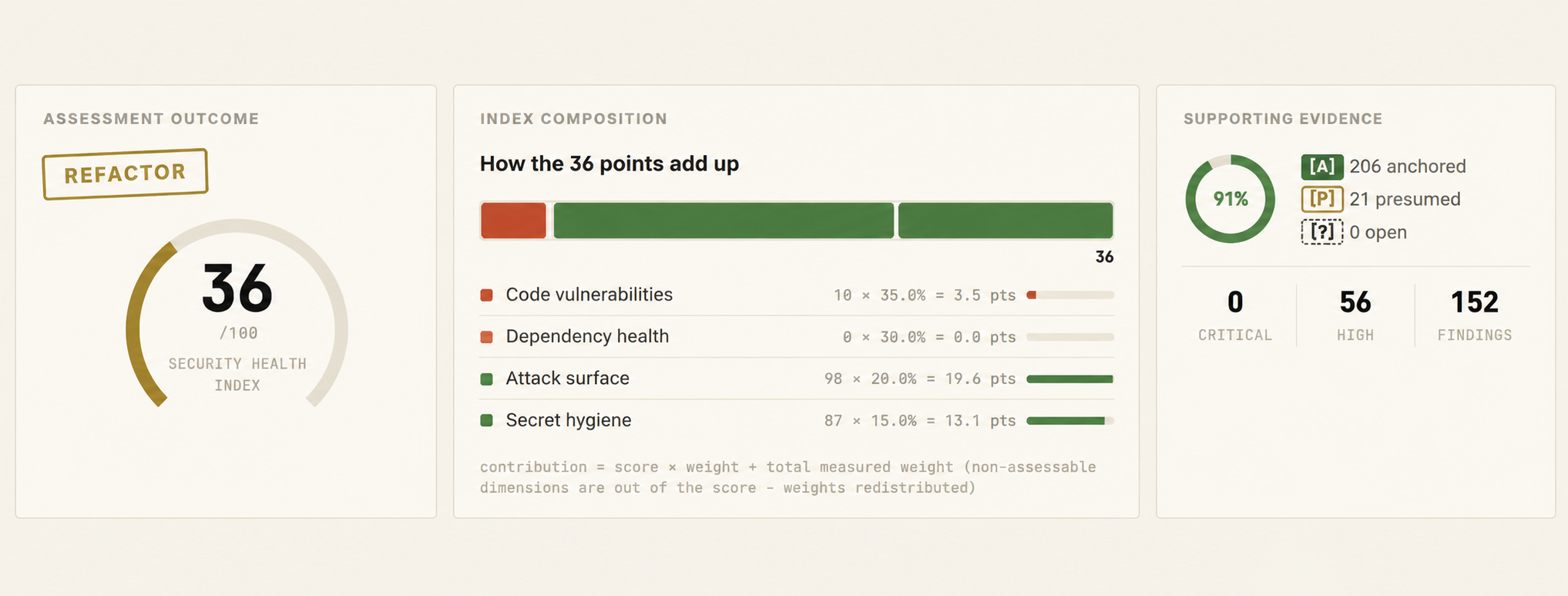
Assessments from different perspectives made architectural, maintenance and security risks visible in TransVoicely. The team gained an organized view of what needed attention.
The detected issues were prioritized. They included critical security concerns requiring a clear path to resolution connected to the product context.
ArchGenerator linked the findings to affected areas and provided guidance for each issue: what to change, what to preserve and how to check the result.
The solutions were organized into tasks, acceptance criteria and checks, guided by our development framework. The team received a structured way to carry out the fixes.
The team implemented the prioritized fixes using the delivered guidance. The plan connects diagnosis to development work and can also guide the team’s preferred coding AI.
The prioritized issues were addressed within the followed scope. The outcome combines reduced exposure to the risks addressed with greater visibility into what was fixed and what still needs attention.
Further analyses help check fixes, identify changes and revisit priorities. ArchGenerator connects diagnosis, implementation guidance and follow-up in an ongoing improvement cycle.
This case covers the issues prioritized within this improvement scope. Further analyses help check what was addressed and guide the next steps.
The Digital Squad connects different perspectives, with your team in control. Each perspective helps answer a question and produce an output.
| Perspective | The question it helps answer | What you receive |
|---|---|---|
| Product and business | Do we need to build this? Which rule needs clarification? | Scope, priorities and decisions. |
| Architecture | Where does the change fit? What does it affect? | Dependencies and architectural guidance. |
| Engineering and security | Which problems deserve attention first? | Evidence, risks and prioritized fixes. |
| Data | Which structures and relationships should be considered? | Data context and requirements. |
| Specification and verification | How do we guide implementation and check delivery? | Stories, criteria and checks. |
You approve the decisions. Your team and your preferred coding AI build.
Better context and clearer decisions can recover capacity at different points in software development.
Bringing rules, dependencies and decisions together reduces the need to restart an investigation for each change.
Clarifying who approves a request before implementation can avoid redesigning the flow later.
Investigating affected components helps reveal impact beyond the first screen.
Recording a decision and its reasoning lets the team revisit it without rebuilding the whole conversation.
Verification criteria make it clearer what needs to be checked in the delivery.
Validating the need and scope may reveal that a simpler rule solves the problem.
More capacity to deliver value.
These are mechanisms of improvement, not a quantitative formula. Factors overlap and results depend on context, input quality and team adoption.
Less effort spent on fixes and operations frees up capacity. Where that also reduces spending, the savings may help fund the engagement. We assess that relationship with you, using your actual situation.
The output is organized context for deciding, implementing and checking. Depth depends on available evidence and the chosen scope.
Findings, risks, dependencies and priorities, with the limits of the analysis stated.
Rules, decisions, stories and acceptance criteria that guide the change.
A plan guided by our framework, with tasks and criteria for your team and your preferred coding AI.
With ArchGenerator’s MCP, Codex, Claude Code and OpenCode access assessments, findings and the remediation framework, along with key platform capabilities, directly in your development workflow and with the permissions you authorize.
Choose your agent’s access and permissions.
Access assessment context, evidence and remediation priorities without leaving your coding agent.
Access the framework and remediation plans to guide the implementation of fixes in your repository.
Key platform capabilities, within your agent’s reach via MCP. You authorize access and your team stays in control of implementation.
Open ArchGenerator ↗The real demo should let you explore the request, decisions and full deliverables. Measured cases will include context and method when available.
Explain permissions, retention and revocation for each connection type. Review Connections and the applicable documents before connecting data.
Choose your starting point and review the platform’s terms before starting a run.
For an existing system, start with a public or authorized repository. For a new idea, describe the problem, users and the rules you already know.
Start with a system diagnosis or an initiative specification. The path and required inputs should be clear before execution.
Review credits and usage conditions in the platform. Human support and certification, when applicable, are separately arranged.
Explore the platform, learn about the method or discuss support. Consultancies, architects and partners can explore Arch Alliance.
Deliverables connected by evidence: ArchGenerator turns real code into diagnosis, decision, specification and governed execution. Start from an existing system or from a new initiative — without losing the traceability between the problem found, the decision made and what will be implemented.
Uncover risks, dependencies, technical debt and evolution points. Nine correlated diagnoses from one scan, plus a dedicated cloud infrastructure assessment — with verifiable evidence in every finding.
Explore the assessments → 02 · DecideCompare systems, see priorities and decide where to invest, maintain, contain or modernize — with a consolidated index and a declared degree of certainty.
See the executive view → 03 · SpecifyTurn an idea — or a finding from the diagnosis — into a complete specification, approved phase by phase and tied to real code.
Learn about Create Spec → 04 · Execute and proveTake the specification into the repository with stories, contracts and executable sensors that guide coding agents and verify that what was agreed was followed.
Learn about the SDD Kit →Repositories, structural database snapshots and the AWS account are available today; observability is in progress. Each new connection expands what the assessment can measure, in a declared way.
REPOSITORIESDATABASECLOUDOBSERVABILITY See ArchConnection → A consultancy, an architect or a commercial partner?Bring architecture intelligence to your clients through referrals, sales partnerships or services under your own brand. Each model has its own terms, presented during partner approval.
Learn about Arch Alliance →Day to day, the assessment already qualifies the decision. When the document needs formal weight — due diligence, audit, dispute — the platform enables human certification: a senior analyst attests and signs the assessment, case by case.
The human signature that gives the document formal weight.
Senior analystUNDER CONTRACT · CASE BY CASE
The most recent article and the two most read: method, evidence, and engineering decisions in practice.
Tell us about your situation. We will explore what you need and shape a Digital Squad engagement around it.
Your inquiry has been received. Our team will get in touch to discuss your situation and next steps.
It is ArchGenerator’s multidisciplinary capability, bringing together digital architects and specialists according to the challenge. These capabilities run through AI agents. The Digital Squad supports your development teams; it is not a dedicated team of people. Human support and assessment certification can be arranged separately.
Generating code is one part of the job. Investigating context, clarifying rules, choosing architecture and checking the result still take time. The Digital Squad works on these areas to reduce ambiguity and rework. Productivity gains depend on your context, the quality of your inputs and adoption by your teams.
Yes. The Digital Squad supports system analysis, architecture decisions and specification development. If and when you choose to introduce AI coding tools, that context and the SDD Kit’s criteria help guide them. Your team remains responsible for implementation and approval.
It analyzes, supports decisions and prepares development through specifications and the SDD Kit. Your teams or coding agents implement the software. Follow-up analysis helps verify progress. The responsible people retain review and approval.
We consider your systems, complexity, depth of analysis and specification volume. Capacity can cover different eligible needs within the agreement. Team size helps us understand your situation; it does not imply a guaranteed staffing equivalent.
Yes. Flex offers prepaid credits for an analysis, specification or a defined initiative. We will help you decide whether Flex or ongoing Digital Squad capacity is the better fit.